|
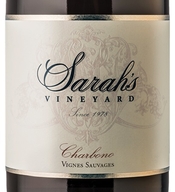 Though rarely seen these days, Charbono can be an extraordinary wine. Tim Slater who owns Sarah’s was fascinated by it and produced his first in 2007 from a neighbor’s vines. He then planted one acre and since 2018 makes one entirely from that vineyard. This 2018 was aged 18 months in French oak, 10% new. Well, that extended aging apparently tamed the beast because from its inky black color to its long vibrant finish, this is a show stopper. Cranberry and blackberry fruit fragrances with back notes of cola and thyme lead to a generous, rich palate. The tannins remain in the background and there’s plenty of acidity to add length to the finish. Leaving the debate about Charbono’s background to the experts, this rendition from Sarah’s Vineyard leaves you wondering why it remains relatively obscure. Though rarely seen these days, Charbono can be an extraordinary wine. Tim Slater who owns Sarah’s was fascinated by it and produced his first in 2007 from a neighbor’s vines. He then planted one acre and since 2018 makes one entirely from that vineyard. This 2018 was aged 18 months in French oak, 10% new. Well, that extended aging apparently tamed the beast because from its inky black color to its long vibrant finish, this is a show stopper. Cranberry and blackberry fruit fragrances with back notes of cola and thyme lead to a generous, rich palate. The tannins remain in the background and there’s plenty of acidity to add length to the finish. Leaving the debate about Charbono’s background to the experts, this rendition from Sarah’s Vineyard leaves you wondering why it remains relatively obscure.
95 Norm Roby
|
|
Posted by Michael Franz on April 17, 2024 at 4:23 PM
Gone are the days when heat was an issue in relation to wine only during summer. With many locations around the world now seeing all-time high temperature averages rising year after year, heat is now an issue during spring as well. I live just outside Washington, DC, and our first 80-degree days hit before Tax Day on April 15. So, what used to be advisable for wine lovers during the summer months has already kicked in. My word “advisable” is really not sufficiently strong, as it is actually imperative that you adjust your practices if you want to derive maximum enjoyment from the wines you buy this time of year.
We should start with red table wines because this is the type most frequently treated in a less-than-optimal manner—even by longstanding wine lovers. Many of us grew up learning the rule of thumb that “red wines should be served at room temperature.” Well, that might have made sense when some guy in an English manor house hatched the idea in the 18th century, prior to the advent of central heating, air conditioning, or the recent round of climate change. These days, that’s often quite bad advice.
For example, if you’d been in DC during one of those recent 80-degree days, odds are that you had your windows open (makes sense after being cooped up during winter), and with a torrid DC summer approaching, you’d probably be unwilling to turn on the air conditioning. That means that “room temperature” at 6 p.m. was probably about 75. In turn, that means that a bottle of red wine teed up earlier in the day for serving with dinner is fully 10 degrees warmer than the temperature at which it would taste best.
Reds that are too warm will show too much alcoholic “heat” in their aromas and aftertaste, and will seem soupy and unfocused, with insufficient acidity and almost no refreshment value. When the weather gets really hot (meaning, anywhere in the 90s), I chill every red that I taste (whether for review or for fun) into the refrigerator for 20 to 30 minutes before opening. Last week in DC, you wouldn’t have needed half an hour in the fridge to get your red set for success, but 15-20 minutes would have made it considerably better.
White and sparkling wines are mishandled less often in my experience as a guest in the homes of others or in restaurants, but most people could get better performance from these wine types (without any additional expense) by being more thoughtful and even experimenting a bit.
I know experts on Champagnes and sparkling wines who dispense what I believe to be bad advice. And to be clear, I mean real experts—not just self-appointed “man-splainers”—who advise consumers to “fully chill” sparkling wines, even to the point of full immersion in ice buckets. My experience indicates that this is bad advice—and demonstrably bad advice at that. A bottle of "fully chilled" Champagne shows much less aromatic complexity than one that has been pulled from a refrigerator for 20-25 minutes, and also seems more tart, with less breadth on the palate and fewer flavor complexities.
This is a fact, and you can test it yourself with ease for free. If you’re hosting a dinner or event for which you’ll need two bottles of bubbly, simply begin by chilling them both for hours ahead of time at your refrigerator’s normal temperature. Then, pull one out and set it on the counter (assuming your room temperature is around 70 or 71 degrees). Set a timer on your phone for 22 minutes, and then open and pour that bottle as well as the one that you’ve just pulled from the refrigerator. I’m utterly confident that you’ll find more complexity and derive more pleasure from the bottle that was pulled earlier, and it makes no difference if the two identical bottles are Champagne, Prosecco, Cava, Franciacorta, or any other type of sparkling wine.
You don’t even need a party to do this. If you have one or two effective sparkling wine stoppers, you can simply stopper up one of the bottles, stick it back in the fridge, and enjoy it later in the week (or even during the following week; sparklers are phenomenally durable if you’ve got good stoppers for them).
Knowing that, you could usefully expand this experiment by using any kind of bucket to really ice down a third bottle, as is often done in restaurants or at outdoor parties served by caterers. Keep that third bottle on ice until some of it melts and there’s nearly as much water as ice in the bucket, then pull one bottle out of your fridge for the 22 minutes, and then open all three after your alarm sounds. You will agree that the iced bottle is the least expressive, followed by the one just pulled from the refrigerator (which will finish 2nd), and that the bottle that was allowed to warm a bit is the best of the bunch.
Everything just noted about sparkling wines holds true for white table wines without bubbles, so our work is nearly done. Even in summer, I would never serve (or review) a white wine that I hadn’t pulled from one of my refrigerators for less than 20 minutes. (And yes, that plural is correct: I have three refrigerators, two of which are devoted to wine, with the 3rd devoted to preserving my marriage.)
The only exception to my advice for whites and sparklers is if you’re going to take the bottles outside to serve on a patio or on an outdoor table on a warm-to-hot evening. In that case, you should not let the wine warm up quite so much as I just advised before serving, for the following reason: If you and your guests will be enjoying a glass for, say, 12 minutes from start to finish, the point at which the temperature should be perfect would be the sixth minute--not the first. If you or a friend find the wine too cold when it is first served, the situation can be remedied by cupping it in one’s hand for 20 seconds. By contrast, it is much more difficult to deal with a glass that goes warm once it has been served.
I don’t wish to come off as being overly cocky, but what you’ve read is less a matter of personal preference than it is the flat-out truth. Of course, it is possible that you have personal preferences that over-ride a professional taster’s seasoned sense of the temperature at which wines are at their best. What should you do then? Whatever you please. The only point of wine is pleasure, and it is your pleasure that counts!
|
|
|
 |
 |
| |
 |
Rich Cook

As Competition Director, it falls to me to select judges for the Winemaker Challenge International Wine Competition, which is a bit of a challenge in and of itself. A winemaker's principal job might be described as hunting for 'issues' in much the same way that a building inspector might check out your prospective home purchase and let you know of any problems before you plunk down your hard-earned dollars. Who wouldn't want that? The difficulty in selecting judges comes in finding a group of those makers who bring together a broad set or experiences with varieties and regions that will result in a balanced look at the wines being judged and be able to celebrate finding something worthy of praise even if it was 'built' by someone else. I believe the top award-winning wines appearing below show a keen attention to not only basic soundness but also nuance and style as well.
|
 |
John McDermott
As I wrote in my last piece, 'Uncorking Value: Where to Find Outstanding Wines Without Breaking the Bank,' truly quality wine can be found for under $35 if you know where to look. Last time, I wrote about value wines from well-known regions. This time, we look at a few regions that-while not unknown by any means - often receive less attention than the quality of their wines should dictate. Join me as we look at wines from the Finger Lakes region of New York; Stellenbosch, South Africa; and Jerez, Spain.
|
|
March 27, 2024: I find myself gravitating towards simpler food, fewer meat-oriented menus, and in general focusing more on simplicity rather than complexity. Simple pasta, for example, is something I've been craving recently. What my palate longs for instead is simple, spaghetti-type pasta, but I want the noodles to be sauced with nothing more, really, than a drizzle of olive oil. Perhaps I'll garnish this simple dish with something raw, and green, and crunchy.
|

Mary Ewing-MulliganMarch 27, 2024: Tuscany is a remarkable wine region. Although most of its red wines are based on the Sangiovese grape - with notable exceptions along the coast - the variety among them is almost endless. Even within a single DOCG appellation such as Chianti Classico, the wines, always 80 to 100 percent Sangiovese, vary from commune to commune and from producer to producer. A case in point is my recent tasting of five Tuscan Sangiovese wines from a single importer, Dalla Terra Winery Direct. This company specializes in family-owned Italian estates and, thanks to its particular distribution model that eliminates the middleman, the wines are all very well priced at retail. More than ranking each wine against the other in terms of quality, I found myself characterizing the wines stylistically to highlight their unique faces. Sassy, pretty, polished, age-worthy or solid and complete: Even this mini selection of Tuscan reds proves what pleasures await an exploration of Sangiovese in Tuscany.
|
|
|
|














 The 16th Annual Winemaker Challenge International Wine Competition Platinum Award Winners
 Uncorking Value Part II: Gems from Overlooked Regions
 Five Takes on Tuscan Sangiovese